Brian Nosek Professional Interests
I study the gap between values and practices - the difference between what is intended, desired, supposed to happen and what actually happens. Why is there a gap? What are the consequences? How can the gap be reduced? I apply this interest to basic science investigations of human behavior, to applied research and examination of organizational behavior, and to scientific practices.
The gap between values and practices - basic science and human behavior
The gap between values and practices is related to a variety of psychological distinctions: intentions versus actions, explicit versus implicit thoughts, endorsed beliefs versus automatic responses, goals versus outcomes, motivations versus behavior, ideology versus reasoning, and moral judgments versus moral intuitions. These are not redundant, but they all recognize that the mind can have multiple responses to the same thing. Most of my research has applied this interest to implicit social cognition - thoughts and feelings that occur outside of conscious awareness or control - but the interest has general application.
Major Reviews
- Implicit social cognition (Nosek, Hawkins, & Frazier, 2011; Nosek, Hawkins, & Frazier, 2012)
- Implicit political cognition (Nosek, Graham, & Hawkins, 2010)
- Policy implications of implicit social cognition (Nosek & Riskind, 2011)
- The Implicit Association Test (Nosek, Greenwald, & Banaji, 2007)
- Implicit attitudes and stereotypes (Nosek, Smyth, Hansen, Devos, Lindner, Ranganath, Smith, Olson, Chugh, Greenwald, & Banaji, 2007)
- Unified theory of attitudes, beliefs, self-esteem, and self-concept (Greenwald, Banaji, Rudman, Farnham, Nosek, & Mellott, 2002)
- Moral foundations (Graham, Haidt, & Nosek, 2009)
- System justification (Jost, Banaji, & Nosek, 2004)
- Automaticity (Andersen, Moskowitz, Blair, & Nosek, 2008)
Examples of research applications building on core interest
- Politics. Political independents are motivated to be objective, but they possess implicit party identities that predict partisan judgment (Hawkins & Nosek, 2011; For more on politics: Smith, Ratliff, & Nosek, in press; Lindner & Nosek, 2009; Nosek, Banaji, & Jost, 2009)
- Morality. Moral intuitions vary across individuals, politics, and can differ from endorsed moral values (Graham, Englander, Morris, Haidt, & Nosek, 2012; For more on moral intuitions see: Graham, Haidt, & Nosek, 2009; Graham, Nosek, Haidt, Iyer, Koleva, & Ditto, 2011)
- Ideology. Ideologies and motives need not be consciously articulated or available to exist and influence behavior (Nosek, Graham, & Hawkins, 2010; For more on ideology and motives see: Jost, Nosek & Gosling, 2008; Jost, Banaji & Nosek, 2004; Jost et al., 2009; Kugler, Cooper, & Nosek, 2010)
- Stereotyping and identity. Implicit gender stereotypes about math and science predict girls' and boys' engagement with science even among people who consciously reject the stereotype (Nosek & Smyth, 2011, AERJ; For more on gender-science stereotypes see: Nosek et al., 2009, PNAS; Nosek et al., 2002, JPSP)
- Attitudes. The processing influencing the formation of implicit evaluations are distinct from those influencing explicit evaluations (Ranganath & Nosek, 2008, PS; Ratliff & Nosek, 2010, JESP; Ratliff & Nosek, 2011, PSPB); mechanisms of change (Joy-Gaba & Nosek, 2010; Schmidt & Nosek, 2010), and sensitivity to the context (Mitchell, Nosek, & Banaji, 2003)
- Implicit cognition. Implicit and explicit evaluations are related, but distinct (Nosek, Banaji, & Greenwald, 2002; Nosek & Smyth, 2007; Nosek, 2007; Ranganth, Smith, & Nosek, 2008) and those relations are a function of the conditions of self-report (Smith & Nosek, 2011) and features of the object of evaluations (Hofmann, Gschwendner, Nosek, & Schmitt, 2005; Nosek, 2005); predicting behavior (Greenwald, Smith, Sriram, Bar-Anan, & Nosek, 2009)
- Culture. The role of culture in shaping implicit and explicit cognition (Nosek & Hansen, 2008; Marini et al., 2012; Nosek et al., 2009; Uhlmann & Nosek, 2012; Uhlmann, Poehlman, & Nosek, 2012)
Advancing scientific theory and evidence relies on the methodology and tools for empirical research. I am interested in the interdependence of theory and measurement and invest resources in advancing both.
Examples of research methodology contributions
- Implicit measures (Bar-Anan & Nosek, 2012): IAT (Nosek, Greenwald, & Banaji, 2005, PSPB; Nosek & Hansen, 2008, EJPA), GNAT (Nosek & Banaji, 2001, Social Cognition), SPF (Bar-Anan, Nosek, & Vianello, 2009), Brief IAT (Nosek, Bar-Anan, Sriram, & Greenwald, 2012), and AMP (Bar-Anan & Nosek, 2012)
- Correlational biases in difference scores (Sriram, Greenwald, & Nosek, 2009)
- Scoring procedures for response latency procedures: IAT (Greenwald et al., 2003), Brief IAT (Nosek et al., 2012), and in general (Sriram et al., 2012)
- Validity and identifying psychological constructs (Nosek & Greenwald, 2009, PB; Greenwald & Nosek, 2008; Nosek & Smyth, 2007, EP; Greenwald et al., 2006, AP)
- Data collection via the Internet (Nosek et al., 2002, JSI; Project Implicit)
The gap between values and practices - applications and organizational behavior
My research interest in the gap between values and practices translates basic science to application. One translational effort is conducting research on (1) the influence of implicit biases in "real world" settings, (2) the effects of interventions and organizational processes to mitigate unwanted biases in decision-making and behavior, and (3) the policy, legal, and organizational implications of implicit bias (Nosek & Riskind, 2011). My lab group includes students and academics in psychology, politics, organizational behavior, quantitative methodology, and computer science and collaborates with academics and professionals in business, education, law, public policy, medicine and health.
As a second translational practice, conducted through our non-profit, Project Implicit, I give lectures and training sessions at corporate meetings, to managers, to HR teams, or to senior leaders on topics such as implicit bias, diversity practices, leadership, and biases in decision-making and barriers to innovation. More information about this is available at Project Implicit's information site.
Examples of research applications to other disciplines:
- Health and medicine. measuring alcohol associations (Houben, Nosek, & Wiers, 2010), weight bias (Schwartz, Vartanian, Nosek, & Brownell, 2006), depression (Haeffel, Abramson, Brazy, Shah, Teachman, & Nosek, 2007), physician biases (Sabin, Nosek, Greenwald, & Rivara, 2009), mental health care (Peris, Teachman, & Nosek, 2008)
- Marketing. attitude transfer across brands (Ratliff, Swinkels, Klerx, & Nosek, 2012)
- Law and policy. policy implications of implicit social cognition (Nosek & Riskind, 2011)
- Education. implicit processes predicting engagement in science, technology, engineering, and math (Nosek & Smyth, 2011; Nosek et al., 2009; Nosek, Banaji, & Greenwald, 2002)
The gap between values and practices - scientific practices
My interest in the gap between values and practices is also applied to public science. We strive to embody our scientific values in our own laboratory operations, and we are interested in improving scientific practices across the discipline.
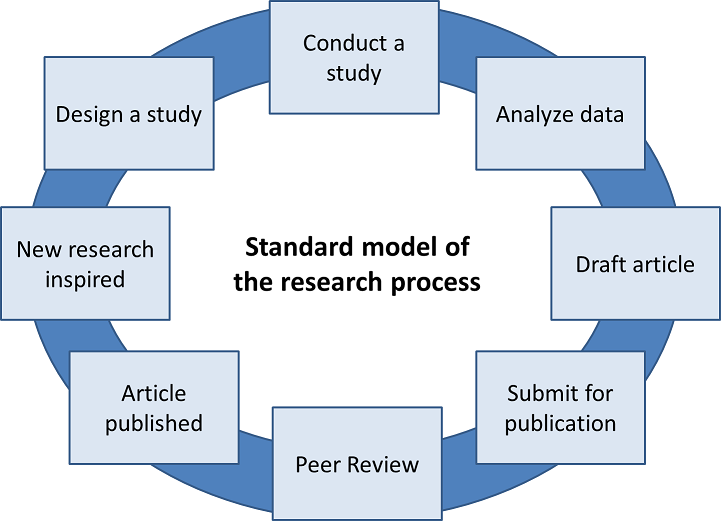
Important scientific values are transparency, accuracy, sharing, reproducibility, cumulative progress, and efficiency. Scientific practices in reality often fall short of these values. My colleagues and I are working on improving the standard model of the cyclical empirical research process (see image) through conceptual, methodological and technical innovation. Some innovations operate within the standard model, and other innovations challenge standard practices. Below is a brief summary of efforts to bridge the gap between scientific values and scientific practices.
Design a study
Through the Center for Open Science, a non-profit Jeff Spies and I founded in 2013, we are developing an open, web-based system and best practices for documenting and tracking the scientific workflow. A useful system will (a) help laboratories organize their studies, materials and data in service of efficiency, (b) make it trivial to share materials and data with others in service of reproducibility and cumulative progress, and (c) provide a mechanism for registering study materials, hypotheses and even analysis scripts prior to data collection or analysis in service of transparency, accuracy, and distinguishing confirmatory versus discovery research.
Conduct a Study
The perfect study is an unrealized platonic ideal. Practical considerations of time, feasibility, resources, availability of tools, and access to samples put reality constraints on what research can get done. This limits the strength of inference, and the efficiency of research progress. We seek to reduce the practical constraints to accelerate knowledge accumulation.
In 1998, we launched a website for the public to experience the Implicit Association Test. That website has evolved into a virtual laboratory with a substantial infrastructure for conducting behavioral research on via the Internet. Known as Project Implicit, the project now consists of multiple public websites: Project Implicit Social Groups (with spin-off international websites in 22 languages), Project Implicit Mental Health, and Project Implicit Research. The latter maintains a volunteer participants pool and hosts studies from many laboratories concerning implicit social cognition. The infrastructure is used for dozens of studies in which researchers direct their targeted sample to a private address. In total, the infrastructure administers more than 20,000 completed study sessions each week, supports the research efforts of hundreds of researchers in dozens of laboratories, and facilitates any behavioral research that can be administered through a web browser. We are expanding capabilities across data collection mechanisms (cell phone, iPad), and developing new sites for other topics such as politics, and research with children. Project Implicit exists as a non-profit to facilitate other laboratories' use of the infrastructure.
These efforts address many of the practical constraints in research, particularly it increases access to samples, delivery of methods and materials without the constraint of participants visiting the laboratory, and enhances the feasibility of conducting high-powered studies.
Analyze data
Besides the substantive research on data analytic approaches, we develop best practices for data analysis to encourage standardization and cumulative progress. We develop and share analysis scripts and tools so that others can easily apply the recommended practices. Finally, we aim to make as much of our data available to other laboratories as possible to facilitate transparency and reproducibility (and even new discovery).
Draft article
Research reports are necessarily an incomplete summary of the research that was done. This has some value for efficiency. Many readers do not need every detail of the research process. But, if it is not possible to access anything but the article, then there are serious risks for transparency and reproducibility. We make our materials, methods, and procedures available on-line whenever possible as a complement to the summary report. Further, to minimize error and maximize communication value, we are developing best practice checklists for use prior to submitting articles for publication.
Publication process - submission, review, publication
The existing publication process is based on old technology - paper. Major improvements in scientific efficiency, accuracy, and transparency can be made if the scientific communication process is reevaluated using modern technology - the Internet - as the means of facilitating communication. A series of lectures and papers (Nosek & Bar-Anan, 2012; Nosek, Spies, & Motyl, 2012) define an imagined scientific utopia and outline practical steps toward approaching that imagined ideal. Also, our laboratory makes manuscripts available as soon as they are submitted following practices that are routine in other fields (e.g., arXiv) to accelerate knowledge accumulation and dissemination.
Inspiring new research
Standard practices in psychological science demand that an individual scientist be competent and involved in every aspect of the research process culminating in the research report. In the context of our study registry and workflow system, we are developing mechanisms of attribution that will diversify contributorship. The research report need not be the only component of research that can be cited as a contribution. Research can give credit to data collection, analysis scripts, or development of measures independent of a research report that applied those methods. This will diversify contributorship.
We are using the Project Implicit infrastructure to expand the potential contributors to science. The infrastructure can be a resource for laboratories that do not have significant research support from their universities - both internationally and across different types of academic institutions. We have a failed grant proposal to build a web-based International Participant Pool in which researchers would contribute samples and withdraw samples in a collective environment so that, for example, recruiting specialized samples becomes trivial. The proposal defines an economy and infrastructure that could serve as an uber-participant pool much like the model of university-based pools.
Finally, we emphasize public dissemination of our results, methods and approaches via our public websites, lectures and training, and accessibility and transparency of as many aspects of the research process as possible. Accessibility means that more minds will be able to consider the research findings and implications and ultimately make new contributions to knowledge.